



Standardized Records and Shared Drive Governance for OCC
The Problem
OCC required shared drive access control list (ACL) remediation and new governance procedures to ensure proper ACL creation and maintenance.
OCC’s official policy is to grant shared drive access based on need to know. Historically, OCC’s shared drive management has been inconsistent with this policy. A review of shared drive ACLs revealed that many users could access data without the required need to know.
To remediate ACLs and close security gaps in shared drive access, OCC faced several challenges:
- Many ACLs had legitimate users (with need to know) comingled with users who did not have need to know, requiring manual review of all shared drive ACLs.
- Many shared drives contained data that had not been touched in years. It was unclear who owned the data or what purpose the data served.
- It was unclear what records retention requirements applied to many shared drives.
The Approach
To meet these needs, OTOT provided project management services to the OCC storage operations team. Our approach covered the following areas:
-

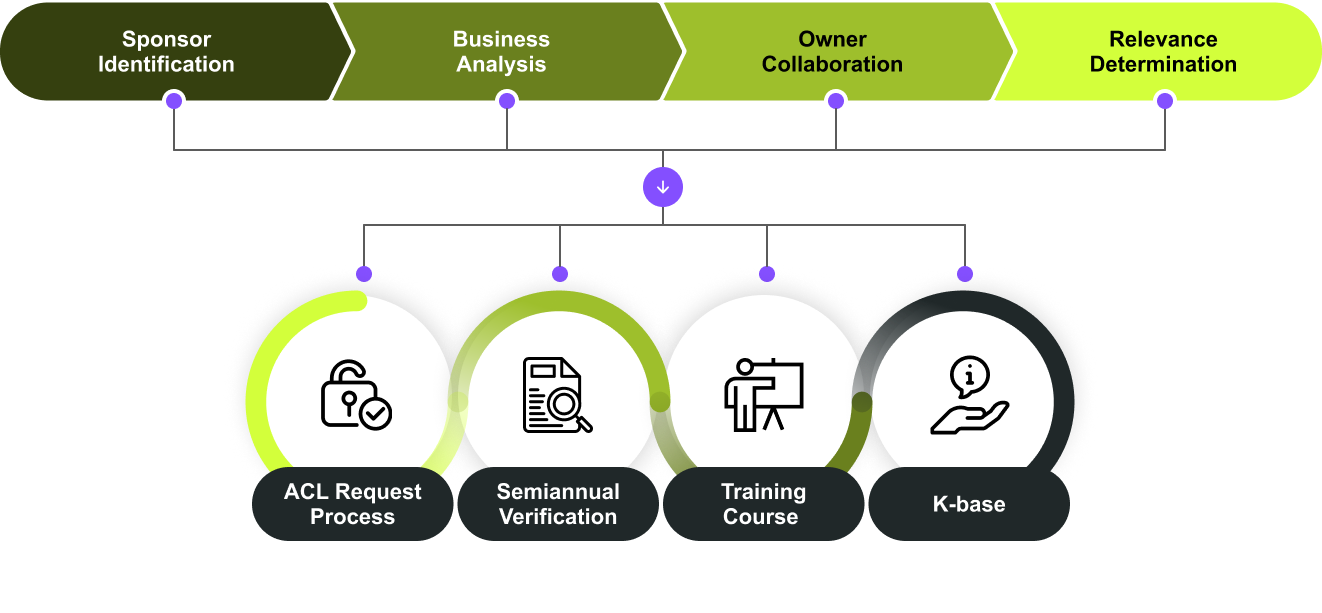
Sponsor Identification
OTOT worked with OCC stakeholders to identify a sponsor for every shared drive. The sponsor understands the nature and purpose of the data that live in the drive, and can determine who has the required need to know.
-
Relevance Determination
OTOT met with assigned sponsors to determine the relevance of each shared drive. We used TreeSize Pro to scan large storage environments and identify file attributes, and Tableau to track determinations as we marked shared drives according to deletion and retention policies.
-
Records Management Review
For shared drives marked for deletion, OTOT collaborated with the records management team to determine archiving requirements.
-
Shared Drive Migration
For shared drives marked for retention, OTOT helped the storage operations team migrate data to a new storage space where shared drives could be more effectively managed in the long term.


The Outcomes
OTOT’s partnership with OCC produced the following results:
- Decommissioned approximately 330 out-of-date shared drives and archived them in accordance with records management requirements.
- Migrated approximately 110 in-use shared drives to a new simplified storage structure and worked with sponsors to manually review ACLs, ensuring all users had the required need to know.
- Created a shared drive ACL request process for users to request access via ServiceNow. Requests route to the shared drive’s sponsor for review and approval.
- Implemented a semiannual verification requirement via SharePoint that calls for sponsors to review and confirm the accuracy of their shared drive ACLs.
- Created a shared drive training course to help sponsors understand their responsibilities.
- Published six knowledge base articles (KBAs) accessible to all OCC users, addressing common questions to reduce the frequency of calls to the Tier-1 helpdesk.
Browse more case studies to see how our customers turn vision into reality.

NAVSEA Automation
Automation for mission-critical system integration testing
OTOT demonstrates massive acceleration and return-on-investment for systems that support mission-critical ship maintenance operations.
Military Health System
Using AI-augmented RPA to Accelerate Prescription Fulfillment
Military Health System (MHS) prescription processing depends on manual entry, delaying fulfillment and creating human errors that interfere with the military personnel tactical readiness.