


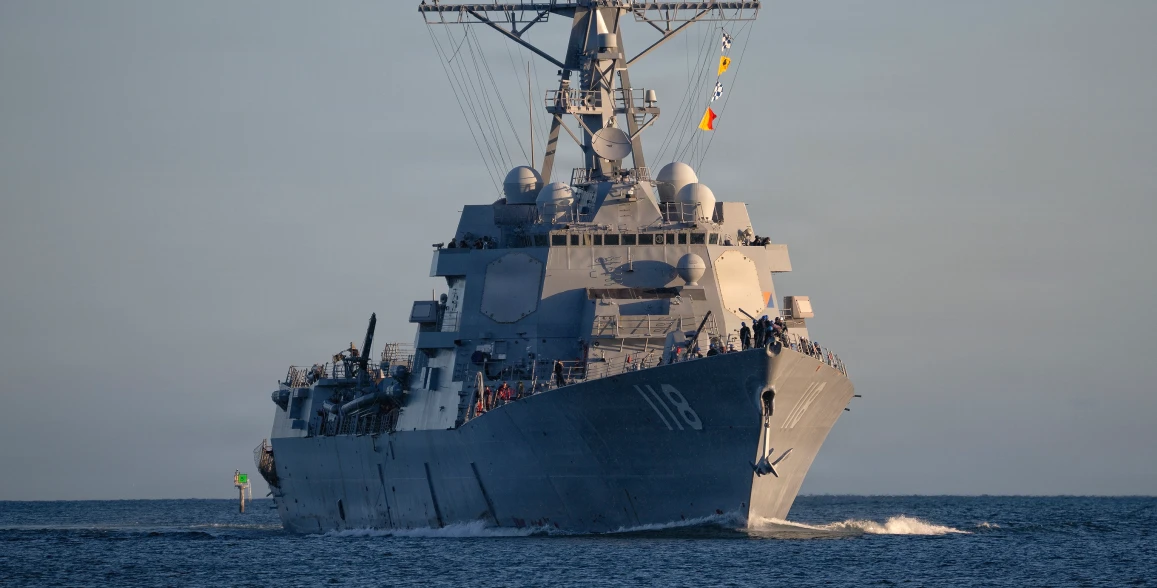
Automation for mission-critical system integration testing
The Problem
Naval Sea Systems Command (NAVSEA) wanted a way to speed up their manual system integration testing (SIT), which lasted six weeks on average and only covered basic regression and new functionality testing.
NAVSEA’s large, complex systems demand extensive regression and functionality testing, yet the three-week SIT window was critically insufficient to meet this growing burden. As system scale expands, the SIT scope continuously outpaced available capacity, forcing the team to reduce test coverage to only risk-based regression and new functionality. The unsustainable compression of test effort left significant portions of the system unvalidated, creating serious risk of defects reaching production and threatening mission-critical ship maintenance operations.
NAVSEA faced several challenges:
- The developer lacked an industry-standard unit test and integration test methodology, forcing the systems test team to compensate with increased test detail and duration that extended beyond acceptable sprint timelines.
- Reliance on manual test execution prevented consistent completion within the three-week sprint.
- Incomplete manual test efforts postponed software releases, deferring critical business value to customers.
- The manual testing approach prevented efficient, repeatable regression testing before delivery to users.
The Approach
To meet these needs, OTOT provided NAVSEA with intelligent test automation. Our approach showcases how automation significantly reduces the burden on manual testing teams:
-

High-Velocity Proof-of-Concept
OTOT developed an automation test suite against the most complex products to showcase throughput and stability at scale while demonstrating our ability to rapidly automate complex, mission-critical ship maintenance workflows.
-
Automated Test Data Generation
OTOT demonstrated how UiPath accelerates regression testing through automated data generation, reducing manual preparation time, minimizing human error, and enabling broader test coverage within constrained sprint timelines.
-
Return-on-Investment (ROI) Modeling & Bakeoff
OTOT conducted comprehensive ROI calculations to confirm automated test development significantly outperforms manual testing in speed and cost, while a competitive product bakeoff validated UiPath as the superior automation solution for NAVSEA’s complex environment.


The Outcomes
OTOT’s partnership with NAVSEA produces the following results:
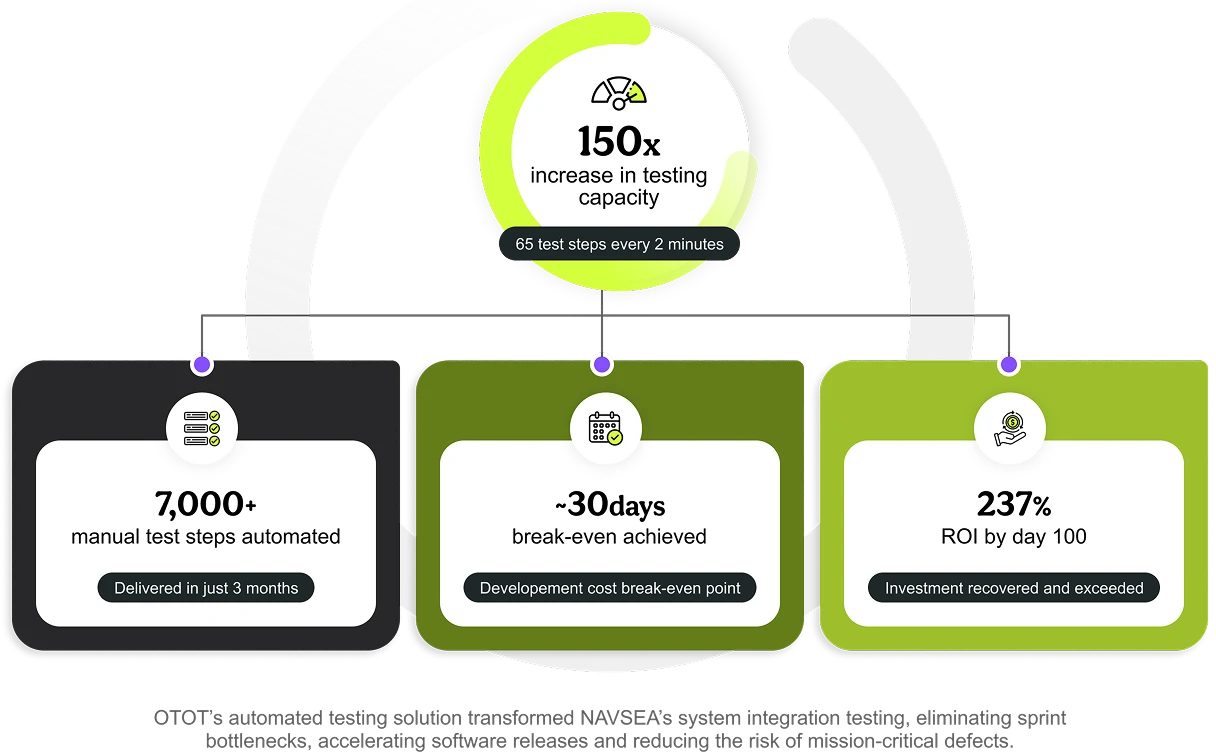
- An automation test suite that replaced over 7,000 manual test steps in just three months.
- Clear demonstration of the development cost break-even point during proof-of-concept at ~30 days, with ROI measured by 100 days at 237%.
- Automated testing averaged 65 test steps every two minutes, resulting in 150x increase in testing
Browse more case studies to see how our customers turn vision into reality.
Military Health System
Using AI-augmented RPA to Accelerate Prescription Fulfillment
Military Health System (MHS) prescription processing depends on manual entry, delaying fulfillment and creating human errors that interfere with the military personnel tactical readiness.
US Coast Guard
Scalable UiPath Automation for the US Coast Guard
By integrating secure, scalable automations aligned with Coast Guard strategic priorities, OTOT enabled faster decision-making, improved data integrity, and a foundation for advanced agentic automation that strengthens readiness, workforce capacity, and mission execution.